These three get compared constantly, but they don't do the same job. Motion is creative analytics: it reads how your ads performed. Foreplay is research and swipe files: it saves and organizes other people's ads and turns them into briefs. Mantinea makes the ads, from research to a finished, localized video. A creative testing loop needs all three jobs done somehow, so pick the tool that covers the most of your loop for the money and fill the remaining gap another way.
Our answer: start with Mantinea, because production is the step that limits how many tests you can run, and it covers competitor research and test variants as well. Add Motion or Foreplay when a specific gap shows up.
Best overall
Best overall
1. Mantinea
The only one of the three that makes the test ads, with competitor research and variants built in
Specifications
- Plans from
- $29/month
- Free trial
- 14 days, 1,000 credits, no card
- Seats
- Unlimited
- Makes video ads
- Yes, with actors, voices and dubs
- API / MCP
- Both, on every plan
Reasons to buy
- +Produces the ads your tests need, from about $4.50 for a 30-second talking ad
- +Ads library pulls, breaks down and remixes competitor ads
- +Variations matrix and Hook lab build controlled test variants
- +Every feature on every plan, with rollover and automatic refunds on failed jobs
Reasons to avoid
- −No manual frame-by-frame timeline editor
- −A newer brand than the other two
Buy it if You need more test variants than your production can supply
Buy it if You want research, production and localization in one tool
Don't buy it if You only need reporting on ads you already have
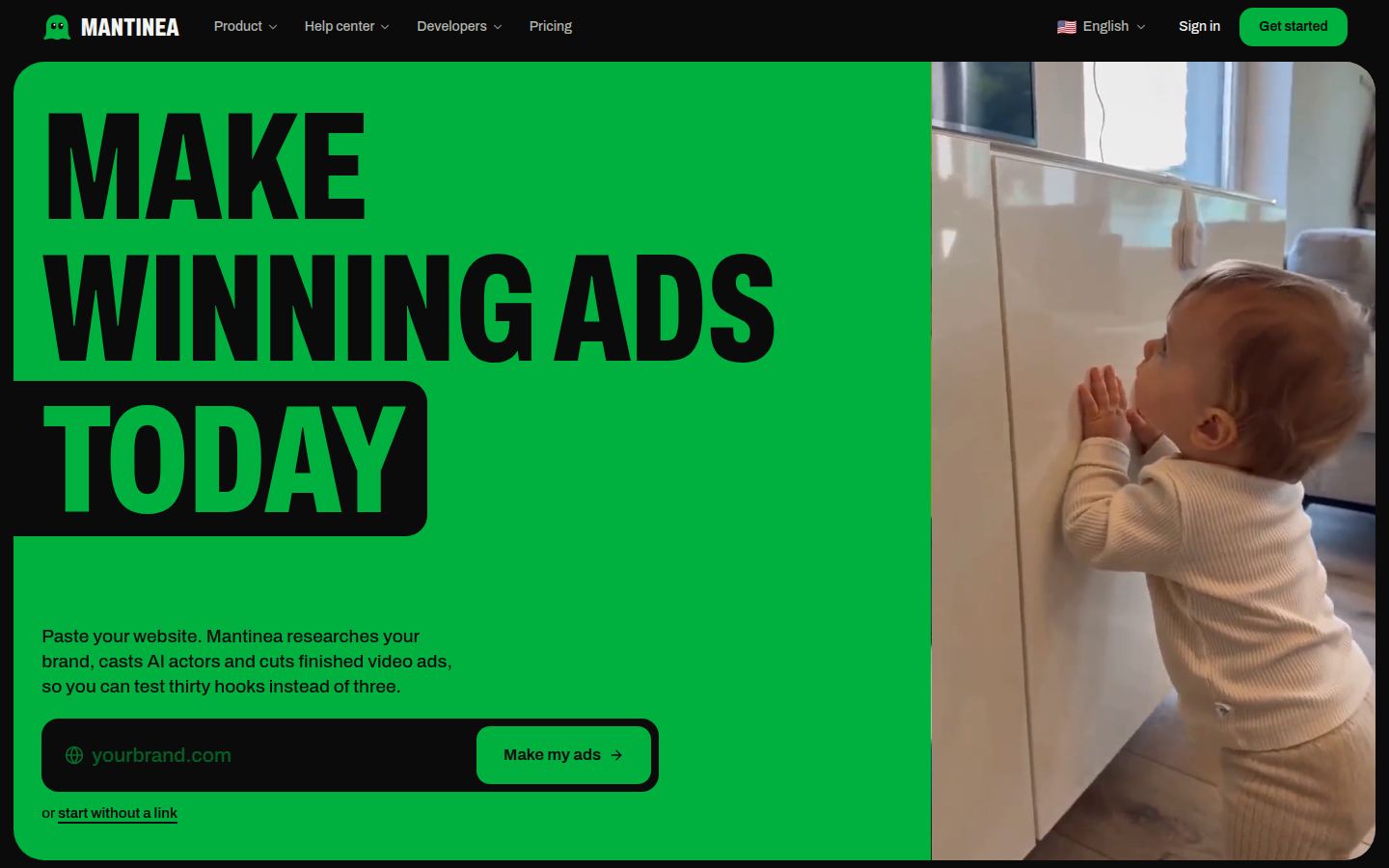
Mantinea's place in a testing stack is the step that usually caps everything else: making the variants. It starts from your website link. Brand Brain reads up to 40 pages of your site and pulls close-up product shots, and for apps it can sign in with a demo login and record real flows, so test ads show your actual product rather than stock footage.
For test design specifically, two features matter. The variations matrix lays out hooks x actors x formats x languages and shows the total creatives and the credit cost before anything runs. Hook lab adds new openings to an ad that already works and renders only the new hook, at 12 credits per second of hook; the body is never re-rendered or billed. Five 3-second hooks cost about $1.80.
It also covers part of the research job. The ads library pulls competitors' running ads, plays them inline, breaks them down and lets you remix a winner into your own ad; the first pull at brand setup is free. Social research adds trend search and creator discovery (up to 20 real TikTok, Instagram, X or YouTube creators per search, with contacts).
Pricing is $29 a month for 2,900 credits, rising to $499 for 55,000, with every feature on every plan, unlimited seats, unused credits rolling over and failed jobs refunded automatically. A 30-second ad with the standard talking actor or a Pro actor (licensed real-actor footage) is 15 credits per second, about $4.50. The public API, hosted MCP server and Claude plugin are on every plan too. Prices as of 24 November 2026; check current pricing before you buy.
Best for creative analytics
Best for creative analytics
2. Motion
Reporting and AI tagging on ads you have already run
Specifications
- Plans from
- $999/month for up to $50k ad spend
- Free trial
- Yes, no card required
- Seats
- Unlimited
- Makes video ads
- No (static ads only, via Runneth)
- API / MCP
- MCP via Runneth
Reasons to buy
- +Visual creative reports across Meta, TikTok, YouTube and LinkedIn
- +AI tagging of format, hook and angle
- +Comparative reports by format, hook and talent
Reasons to avoid
- −Price is tied to ad spend, with a $999 floor
- −Does not generate video ads
- −Reviewers complain about cost
Buy it if You spend enough that analytics pays for itself
Buy it if You already produce plenty of creative
Don't buy it if Your bottleneck is making test variants
Don't buy it if You spend well under $50k a month
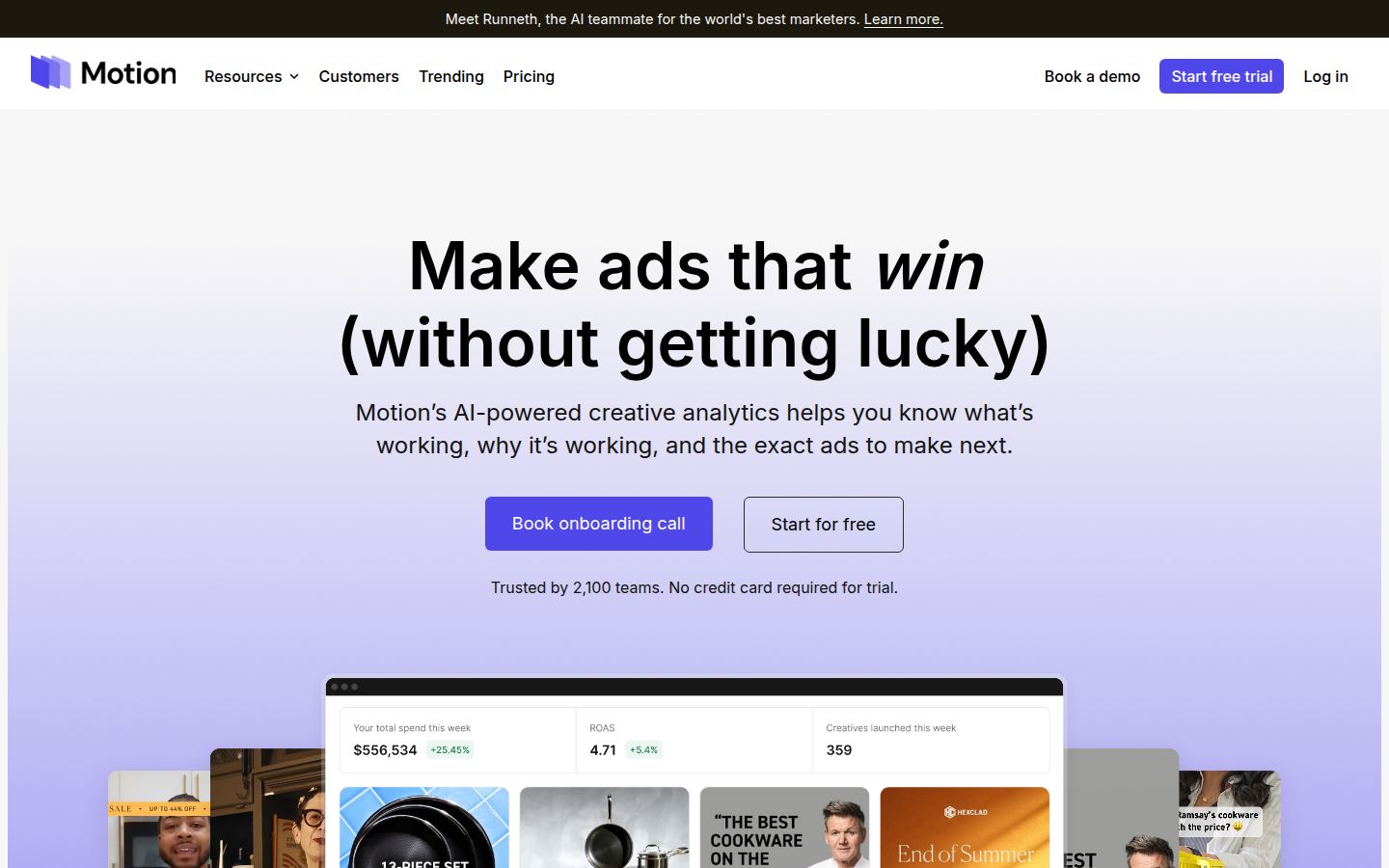
Motion describes itself as "Make ads that win (without getting lucky)". It reads your ad accounts and turns performance into visual creative reports, with AI auto-tagging by asset type, format, hook and angle, frame-by-frame drop-off, and comparative reports across formats, hooks, talent and agencies. It's now sold with Runneth, an always-on agent that adds concepting, static ad generation, creator briefing and routines.
The constraint is price. The Starter plan was $999 a month for up to $50,000 of monthly ad spend (averaged over 12 months) when we read the pricing page on 12 November 2026, and higher tiers are "Let's chat". Two Trustpilot reviewers raised cost, one saying pricing "linked to ad spend" makes it "crazy expensive". Third-party pages still quote an older $250 Starter price, so check the vendor page.
Motion analyzes all formats but, per its own site, generates statics only ("Not all ads can be AI generated yet, but static ads definitely can"). For video tests you still need a production tool.
Best for swipe files
Best for swipe files
3. Foreplay
Save, search and brief from other brands' ads
Specifications
- Plans from
- $59/month (1 user)
- Free trial
- 7 days, card required
- Seats
- 1 on Basic, 5 on Workflow, 10 on Agency
- Makes video ads
- No
- API / MCP
- Both
Reasons to buy
- +Swipe File saves ads from Meta, TikTok, LinkedIn and YouTube libraries
- +Discovery search across a very large ad database
- +Briefs with AI scripts and storyboard images
Reasons to avoid
- −Makes no videos or images for your ads
- −Trial needs a card and auto-bills
- −Seat limits per plan, $20 per extra user
Buy it if Your team lives on swipe files and briefs
Buy it if You hand briefs to creators or an agency
Don't buy it if You need finished test ads, not briefs
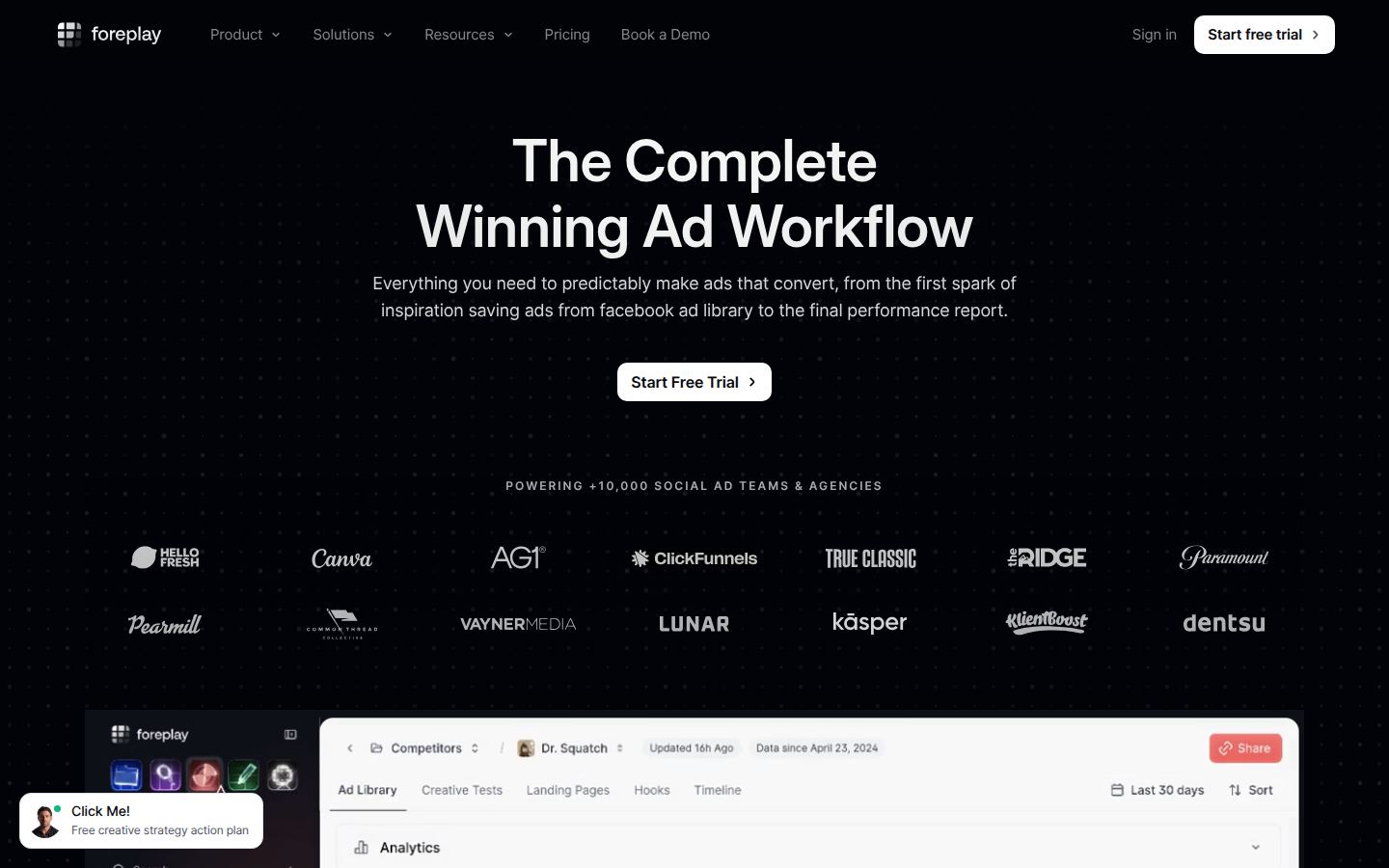
Foreplay calls itself "The Complete Winning Ad Workflow". Swipe File saves ads from the Meta Ad Library, Instagram, TikTok, LinkedIn and YouTube Shorts with a Chrome extension. Discovery is a searchable community ad library. Spyder tracks competitors' Meta ads with up to three years of history, and Lens adds analytics on your own Meta and TikTok accounts. Briefs turns research into scripts and storyboards.
As of 12 November 2026, Basic was $59 a month ($49 yearly) for one user; Workflow $175 ($149) for five users with Spyder, Lens for one brand and MCP; Agency $459 ($389) for ten users. Extra users are $20 each. The trial is 7 days with a card and bills automatically, with a 14-day money-back window after the first charge and no refunds on annual plans.
The gap is production. Foreplay generates scripts and storyboard images, not ads. Its $175 Workflow plan makes zero videos, so you still pay creators, an agency or a production tool to turn a brief into something you can test.
How they fit together in a testing loop
| Loop step | Mantinea | Motion | Foreplay |
|---|---|---|---|
| Research competitor ads | Yes, ads library per brand, with breakdown and remix | Agent tracks rivals' latest ads | Yes, Swipe File, Discovery, Spyder |
| Write concepts and scripts | Yes, agent and templates | Yes, via Runneth | Yes, Briefs |
| Produce video test ads | Yes, actors, voices, product shots | No | No |
| Build controlled variants | Yes, variations matrix and Hook lab | Not listed | No |
| Localize winners | Yes, up to 10 of 182 languages at once | Not listed | Scripts in 150+ languages, no video |
| Read results | Hook lab results log and CSV export | Yes, full creative reporting | Yes, Lens |
| Entry price | $29/month | $999/month | $59/month |
| Trial | 14 days, 1,000 credits, no card | Yes, no card required | 7 days, card required |
| Seats at entry | Unlimited | Unlimited | 1 |
If you pick one, pick the one that removes your bottleneck. For most teams running structured tests, that bottleneck is variants: you know what you want to test but can't produce it fast enough or cheaply enough. That's Mantinea's job. If you already have plenty of creative and can't tell what's working, an analytics tool helps. If you brief human creators and want a library to brief from, a swipe-file tool helps.
Between the two non-production tools, Foreplay is the better fit for most teams: it starts at $59 rather than $999, and its swipe files feed straight into briefs. Motion makes sense once your spend is high enough for the analytics floor to be a small share of it. Mantinea covers the production job both of them leave open, plus a working competitor-research step, which is why it's our pick to start with.
For building a research habit inside Mantinea, see the winning ads swipe file guide. For what to do with the results once you have them, see logging creative test results.
How we compare these tools
We read each vendor's own pricing pages, product pages and help centers, and we date every price: Motion and Foreplay as of 12 November 2026, Mantinea as of 24 November 2026. Where we quote reviews, they come from public review sites and are labelled as such. We did not run hands-on tests of these tools for this article. Prices and plans change, so check each vendor's page before you buy.
FAQ
Can Motion or Foreplay make video ads? No. Foreplay generates scripts and storyboard images. Motion, through Runneth, generates static ads. Neither produces video ads with presenters.
Does Mantinea replace a swipe-file tool? For competitor research tied to production, often yes: the ads library pulls competitors' running ads per brand, breaks them down and remixes them. Teams that collect ads across many brands as a daily habit may still want a dedicated swipe-file tool alongside it.
Which has the cheapest way to start? Mantinea, at $29 a month with a 14-day, 1,000-credit trial that needs no card. Foreplay starts at $59 with a card-required trial; Motion starts at $999.