Synthesia is good at polished presenter videos: explainers, product walkthroughs, onboarding, training. For paid social ads, it is an awkward fit. It was not built for hooks, variations or UGC formats, and its moderation of every video slows the fast iteration ads need.
This take is based on Synthesia's pricing page, credits help article, docs and Trustpilot, read on 12 November 2026. We did not run a paid account. We judge Synthesia on ad work.
What Synthesia is
Synthesia calls itself an "AI Video and Avatar platform for business". Its customer stories are mostly training, compliance, internal comms and sales enablement. On its avatars page, ads appear as one bullet: "Generate and test multiple ad variations."
Key features:
- Stock avatars, including full-body and expressive ones; personal avatars from one photo or a short video; an Avatar Builder that makes an avatar from a prompt.
- AI Video Assistant that turns a doc, deck or link into a video; 60+ templates; a screen recorder.
- Translation with a glossary and a multilingual player. AI dubbing covers 70+ languages on self-serve plans.
- Approvals ("require approval before videos go live"), roles, share pages, embeds, SCORM on Enterprise.
- Interactive avatars for roleplay and surveys.
- A REST API.
Pricing
| Plan | Monthly | Yearly (per month) | Credits / month |
|---|---|---|---|
| Basic | $0 | None | 500 + 10 min of video |
| Starter | $19 | $14 | 1,750 |
| Pro | $89 | $59 | 6,500 |
Extra seats are $29 a month each. Those are US prices; the non-US card was higher (Starter $29 monthly). Paid-plan trials were offered only in the US. Check before you buy.
Where it works for marketing
- Product explainers and demos of a minute or more, especially with screen recordings.
- Multilingual corporate video with a glossary and multilingual player.
- Teams that need approvals before anything is published.
- Website and landing-page video where polish matters more than native feel.
Where it struggles for ads
Moderation. Synthesia moderates every video with human and AI review, and restricts topics including politics, religion, and health, legal and financial claims. One reviewer: "Every generated video goes to manual moderation and you have to wait until their censor check your every single word." Another reported clinically approved NHS content being rejected. For an ad team shipping 20 variants a week, that queue matters.
No UGC formats. There are no testimonial-style, unboxing or problem-solution ad templates, no hook testing tools, and no competitor ad research.
Presenter look. Synthesia's avatars are business presenters. Paid social rewards a phone-shot, native look.
No 4K. A Trustpilot reviewer: "no 4K resolution ... at least twice as expensive as other similar companies."
No first-party MCP server, if you plan to drive production from an AI agent.
Seats cost extra. Every additional person is $29 a month.
Other repeated Trustpilot themes: price and mispronunciation of industry terms.
A brief that shows the gap
Brief: 20 vertical 15-second hooks for a skincare launch, three actors, English and Spanish, live by Friday.
- Hooks: Synthesia has no hook generator or hook testing; you write all 20 yourself.
- Actors: business presenters, not phone-shot creators in a bathroom.
- Formats: no testimonial, unboxing or problem-solution templates.
- Review: every one of the 40 renders goes through moderation, and skincare claims sit close to its restricted health topics.
- Variation: no matrix to cross hooks, actors and languages in one go.
Swap the brief for a 90-second B2B walkthrough with screen recordings and legal sign-off, and Synthesia handles it comfortably, because that is the work it was built for.
What we liked
- Polished presenters for explainers.
- An approval workflow before videos go live.
- Translation tooling with a glossary.
What bugged us
- Moderation of every render.
- Restricted claims topics that cover many ad categories.
- No ad-native formats or testing tools.
- US-only paid trials and $29 extra seats.
The ad-first alternative we pick: Mantinea
Our pick for ads
1. Mantinea
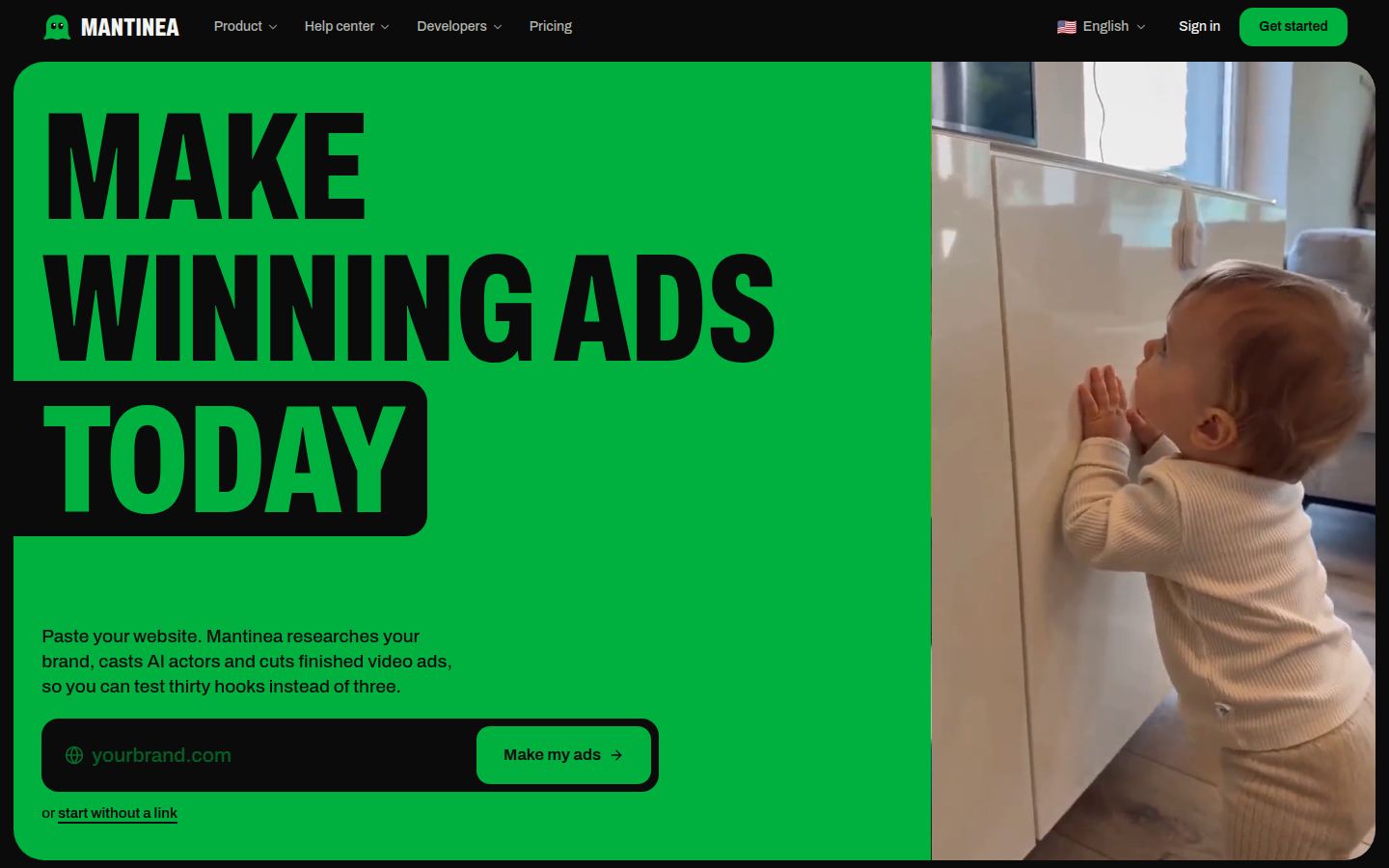
Built for paid social: UGC formats, hook testing and 182-language dubbing
Specifications
- Plans from
- $29/month (2,900 credits)
- Free trial
- 14 days, no card, any country
- Seats
- Unlimited on every plan
- Languages
- 182, up to 10 at once, lip-synced
- Ratios
- 9:16, 1:1, 16:9
Reasons to buy
- +16 UGC formats including testimonial, problem-solution and unboxing
- +Hook lab, variations and a competitor ads library
- +Unlimited seats and every feature on every plan
- +Upscale to 4K, captions and Brand finish
Reasons to avoid
- −No manual frame-by-frame timeline editor
- −No blanket moderation queue, so scripting responsibly is on you
Buy it if You make short paid social ads and test them weekly
Buy it if You localize ads into several markets
Don't buy it if You build SCORM training courses or interactive roleplay avatars
Run the skincare brief through Mantinea and every step has a tool. The free hook generator and the agent draft openings, the Variations matrix crosses those hooks with three actors and two languages and prices the batch before it runs, and hook lab later renders new openings on the winner while billing only the new seconds. Templates cover 16 UGC formats, from testimonial and problem-solution to unboxing reaction and day-in-the-life.
For actors you can use the synthetic library, Pro actors (licensed footage of real stock actors filmed in their own settings, 1,100+ takes) or your own actor from a photo. Library actors are fictional presenters, so label testimonial-style ads honestly, and keep claims within the ad platforms' own policies in categories like skincare, health or finance.
Dubbing reaches 182 languages, up to 10 at once, lip-synced. Finishing is built in: captions, Brand finish (captions, logo and end card in one step, free preview), Edit video to rewrite a line without re-rendering the whole ad, resize to every placement and upscale to 4K. Reviews with timecode comments and approvals keep sign-off in the same workspace.
The plan terms suit a team. Every feature is on every plan from $29, seats are unlimited instead of $29 each, the trial is 14 days with no card, unused credits roll over and failed jobs are refunded automatically. A standard 30-second talking-actor ad costs about $4.50 (checked 24 November 2026).
Verdict
Synthesia is worth it for marketing managers making explainers, onboarding and multilingual corporate video in companies that want an approval step on every render.
For paid social, pick Mantinea. Native UGC formats, hook testing, competitor research and 182-language dubbing are built in, with no moderation queue between you and Friday's launch. For other presenter tools, see our avatar ad tools comparison and our spokesperson roundup.