If the videos are ads, Creatify beats Synthesia. If the videos are training, onboarding, compliance or internal comms, Synthesia is the one built for that job. Both use AI avatars, which is why marketing managers mix them up, but the wrong one costs you in moderation delays, missing ad tools or seats you do not need. And if your team makes ads with more than one person, Mantinea is the ad platform we would pick over both.
Facts are from each vendor's pricing pages, help centers and docs, read on 12 November 2026. Synthesia's US price book is quoted. Check before you buy.
The one-minute answer
| Creatify | Synthesia | |
|---|---|---|
| Who it is for | Brands, agencies, ad platforms | Enterprise L&D, internal comms, sales enablement |
| How it talks about ads | "AI Ads that win" | One bullet on the avatars page |
| Ad tools | Ad Agent, URL to Video, Ad Clone, Competitor Ad Tracker, launch to Meta, Google, TikTok | None of these |
| Training tools | None | Interactive avatars (roleplay, surveys), SCORM, LMS Smart Updates |
| Moderation | Not listed as blanket | Every video goes through human and AI moderation |
| Entry paid price | $15/month (Standard) | $19/month (Starter, US) |
| Free option | Free plan, 10 credits, watermark | Free Basic, 500 credits + 10 min/month, watermark, no download |
| Paid-plan trial | Free plan instead | US only |
| Languages | 75+ | 140+ video; 70+ dubbing on self-serve |
Signs you need Creatify
- Your videos run 15 to 60 seconds and end with a call to action.
- You test hooks and need many versions of one script.
- You want to connect ad accounts and launch from the same tool.
- You want to see what competitors are running.
Creatify has an Ad Agent with 40+ playbooks (hook multiplier, creative fatigue refresh, competitor analysis, ad localizer, remake shot for shot), URL to Video, Ad Clone and a Competitor Ad Tracker on Pro and up. It reads data from Google Analytics, Shopify and HubSpot and launches to Meta, Google, TikTok and OpenAI.
Watch-outs: the Ad Agent spends plan credits on chat, credits roll over for only one extra month, and the policy is "no refunds". Seats and brand spaces stay at one until Ultra ($95), and the API is a separate $99 to $299 subscription.
Signs you need Synthesia
- Your videos are long modules, not 30-second spots.
- They live in an LMS or an internal portal, not an ad account.
- You need SCORM and approvals before publishing.
- You want interactive avatars for roleplay or surveys.
Synthesia has an AI Video Assistant that turns documents, PowerPoints or links into video, Personal Avatars from one photo, an Avatar Builder, interactive real-time avatars, 1-click translation, and "require approval before videos go live". Its customer stories are almost all employee training, compliance, internal comms and sales enablement.
Why Synthesia is a poor fit for ads
Three things get in the way.
Moderation. Every Synthesia video goes through human and AI moderation, and restricted topics include health, legal and financial claims. One Trustpilot reviewer: "Every generated video goes to manual moderation and you have to wait until their censor check your every single word." Another said content clinically approved for NHS England kept getting rejected. For training, that is a safety feature. For an ad team shipping 20 variants by Friday, it is a bottleneck, and it hits exactly the categories (supplements, finance) that spend most on UGC-style ads.
No ad tools. No hook tests, no competitor ads, no ad account connections, no UGC formats. You would build all of that around it.
Trials and resolution. Paid-plan trials are offered only in the US. A reviewer noted "no 4K resolution", and we did not find 4K on the pages we read.
Why Creatify is a poor fit for training
Creatify has no SCORM or LMS features and no interactive avatars. Its tools are shaped around short ads, playbooks and ad accounts. You could make a short explainer, but a compliance course belongs in a training tool.
Pick Creatify if
You are one marketer making short paid social ads for one brand and want ad account connections in the same tool.
Pick Synthesia if
You are making training, onboarding or internal video inside a company that needs an LMS and approvals.
Our pick for ad teams
Creatify's single seat until $95, its separate API plan and its one-month rollover are the usual sticking points for small ad teams. Mantinea is ad-first like Creatify, with team terms on every plan.
Our pick for ads
1. Mantinea
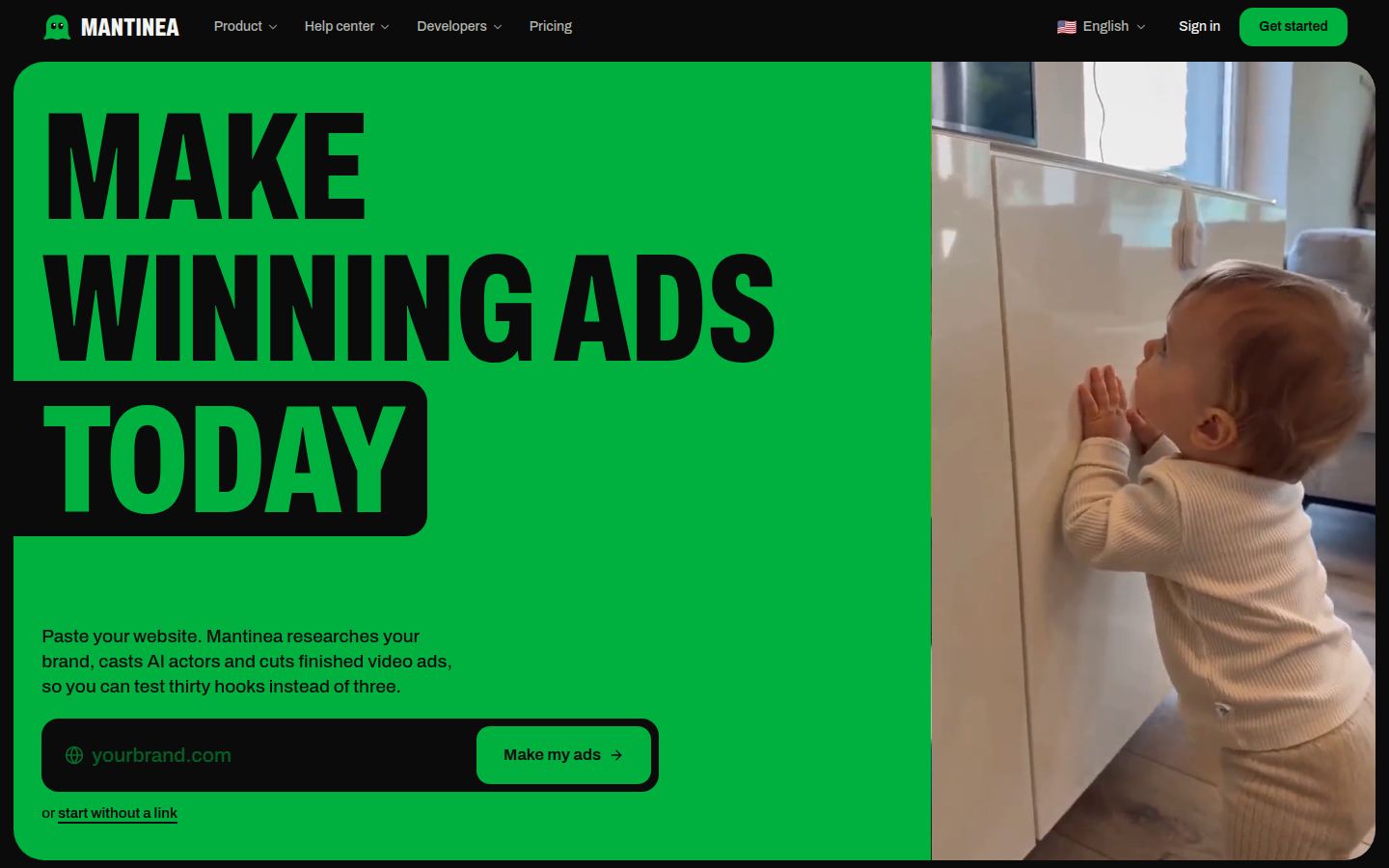
An ad platform with unlimited seats, rollover and the API from $29
Specifications
- Plans from
- $29/month (2,900 credits)
- Free trial
- 14 days, 1,000 credits, no card, worldwide
- Seats
- Unlimited on every plan
- Languages
- 182, up to 10 at once, lip-synced
- Approvals
- Timecode comments, every plan
Reasons to buy
- +Ads library, hook lab and variations matrix on every plan
- +Reads your site and app so the real product is in the ad
- +Rollover with no cap; failed jobs refunded automatically
Reasons to avoid
- −No manual frame-by-frame timeline editor
- −Not a training or LMS tool
Buy it if Your videos are paid social ads made by a team
Buy it if You sell in several languages
Don't buy it if You need SCORM courses for an LMS
Mantinea's Brand Brain reads up to 40 pages of your site and can sign in to your app with a demo login to record real product flows. The ads library pulls competitors' running ads to break down and remix. Hook lab renders a new opening on an ad that already works and bills only the new seconds, and the Variations matrix prices a full run of hooks, actors, formats and languages before it starts.
Casting covers a synthetic library, Pro actors (licensed footage of real stock actors filmed in their own settings, 1,100+ takes) and your own actor. Finishing covers captions, Brand finish, Edit video, resize and dubbing into up to 10 of 182 languages at once. Reviews and approvals with timecode comments are on every plan, which is the one Synthesia feature ad teams usually miss. A standard 30-second talking-actor ad is about $4.50.
More on the training-vs-ads split: Mantinea or Synthesia? and HeyGen vs Synthesia (2026).